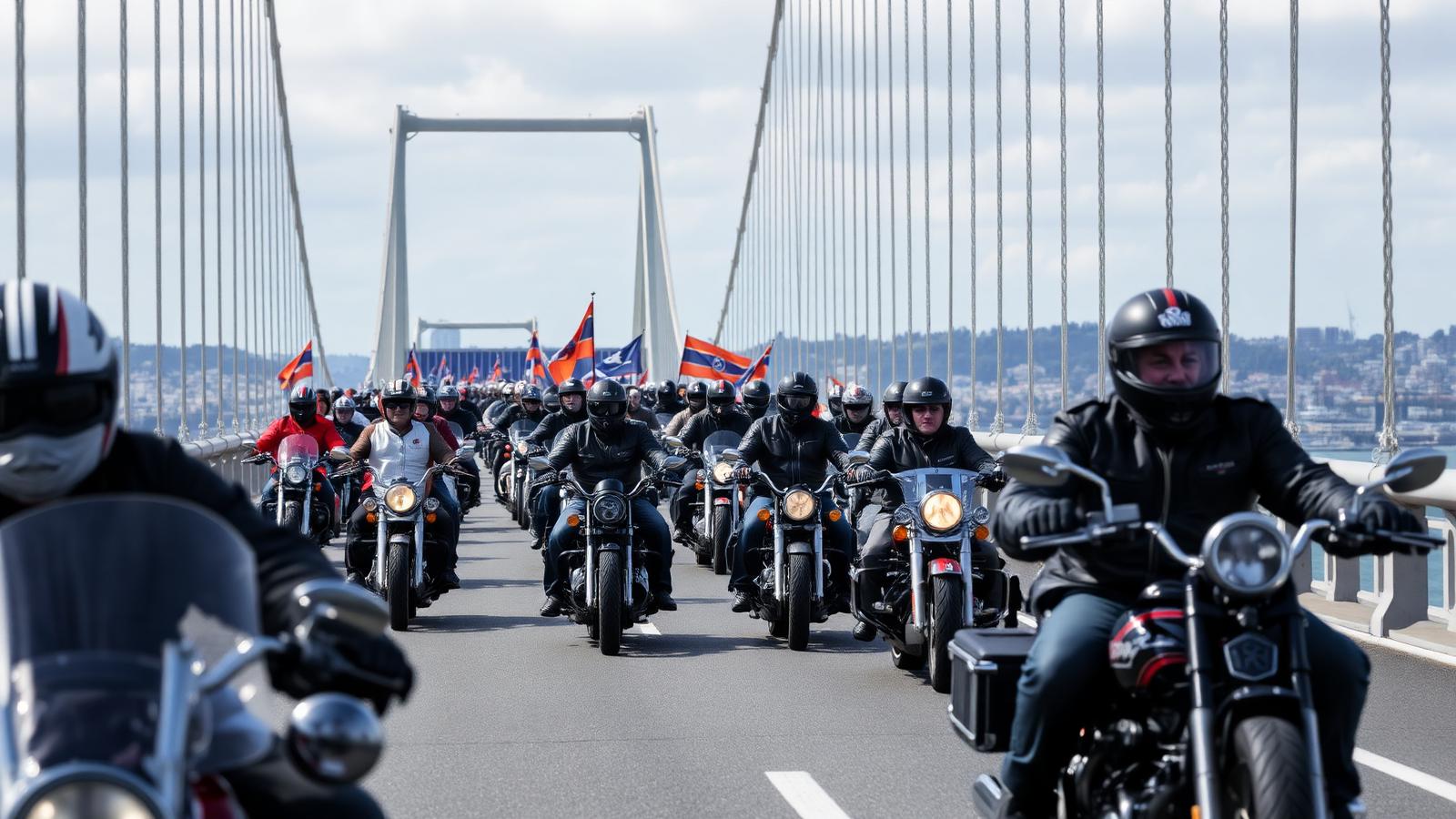
They came from Hamilton, from Tauranga, from the Far North — leather-clad, engines roaring, flags snapping in the cool autumn air. By the time the convoy moved off from Onepoto Domain on Auckland's North Shore at 12.30pm on Saturday, organisers had stopped trying to count the bikes. One rider posted on Facebook that there were "way more than 400" — and the procession that eventually streamed across the Auckland Harbour Bridge and back through the city centre bore that out. For a brief, noisy hour, the bridge belonged to them.
The protest was organised by Motorcycle Advocacy Group New Zealand (MAGNZ), and its grievance is specific: a coming hike in ACC levies that will push registration costs for large-capacity motorcycles from roughly $540 this year to about $816 from July 1 — and then again to $960 by 2027. The group says the increases are not only financially painful but legally dubious, and it is now preparing a representative action in court to try to stop the next increase before it takes effect.
MAGNZ spokesman Richard Tohu described the levy structure as "unlawful and unfair." His central argument is that ACC uses engine displacement as the basis for grouping motorcycles into risk categories, while ignoring power-to-weight ratio. Under the current framework, a heavy touring bike and a lightweight high-performance machine can attract the same levy simply because they share an engine size category, even if their actual risk profiles diverge significantly.
ACC, for its part, has defended the structure at length. Deputy chief executive Stewart McRobie told media that motorcycles currently cover only 28 percent of their total claim costs — a figure that will rise to 33 percent from July and 37 percent the following year. The remaining share is effectively subsidised by other road users. ACC data shows that while crash likelihood does not vary dramatically between motorcycle types, the severity and cost of injuries increases substantially with engine size.
New Zealand's motorcycle fleet accounts for just four percent of all registered vehicles on the road, yet motorcycle accidents represent approximately 25 percent of the total cost to ACC of all road crash injuries — around $266 million annually. For ACC, these statistics justify higher levies. For MAGNZ, they reflect systemic underinvestment in road safety infrastructure and rider training that the riders themselves should not have to fund alone.
Auckland Transport and NZTA monitored the protest closely, and police confirmed they had been in discussions with organisers ahead of the event. Traffic disruption was modest — the convoy occupied the two leftmost lanes on the bridge at speeds of around 40km/h against the normal 80km/h flow, but overall congestion remained minimal. Whether the same can be said of the legal and regulatory disruption still to come is another question entirely.