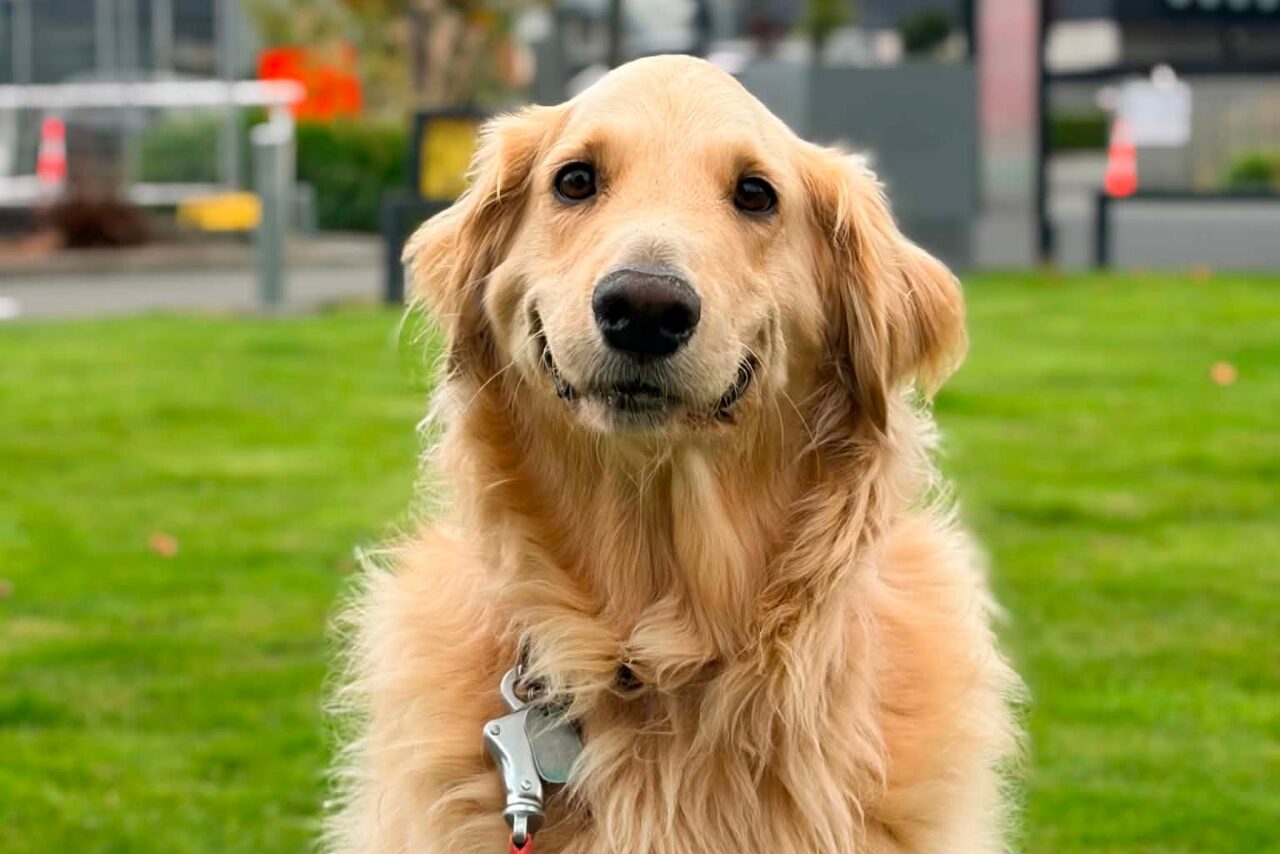
Mak, a five-year-old golden retriever from Diamond Harbour, is preparing for rare jaw surgery after years spent helping people across Canterbury as a therapy dog.
Mak has lived since puppyhood with temporomandibular joint ankylosis, a condition that fused his jaw joint and left him unable to open his mouth normally. His owner, Kaye Jones, said Mak has never been able to pick up a tennis ball, catch a treat or enjoy a proper yawn. The condition has now become critical because one of his lower canine teeth has grown upward through the roof of his mouth, creating a hole into his nasal cavity.
A Givealittle campaign describes the same core situation: Mak needs life-changing TMJ surgery to release his fused jaw, repair a painful palate defect and allow him to live more normally. The campaign is based in Christchurch, Canterbury.
Mak is well known in the community because he has worked through St John's Therapy Pet Programme, Christchurch Airport's PAWS programme, and as a school dog at Broadfield School near Rolleston. The story is therefore not simply about one pet needing treatment. It is about a working therapy animal whose calm presence has already supported patients, anxious travellers, students and staff.
Jones said Mak has adapted remarkably despite a condition that is both debilitating and life-limiting. Standard dental treatment is not possible because his jaw will not open enough for ordinary repair. The planned September operation is expected to involve a multidisciplinary team, including veterinarians, anaesthesia specialists, dentistry and maxillofacial experts, with international specialist input because of the rarity of the condition.
Veterinarians believe the procedure may be the first of its kind performed in New Zealand. That claim should be treated carefully. It is reported as what veterinarians believe, not as an independently confirmed national register of every similar surgery. The verified public-interest point is still strong: the procedure is unusual, complex, expensive and potentially useful for future rare cases.
Mak's story also carries a personal thread. Jones lost her husband, Pete, to cancer when Mak was seven months old. She said Mak has been by her side every day since then. That context helps explain why the fundraising is not being framed only as a veterinary bill. Mak has been part companion, part support worker and part community presence.
Canterbury has many volunteer-driven services that depend on animals and handlers giving time in quiet, practical ways. Therapy pets visit schools, hospitals, airports and community spaces where anxiety, grief or stress can be high. Their value is often seen in small moments rather than formal statistics: a child reading aloud, a traveller calming down, a patient smiling, or a staff member getting a brief pause in a difficult day.
The cost of surgery, rehabilitation and South Island to North Island travel is significant. Friends and supporters have set up a Givealittle page to help, but Jones said the story is not only about fundraising. Her point was that Mak has spent most of his life helping other people, and now he needs help himself.
For Christchurch and Canterbury readers, the immediate takeaway is that a familiar therapy dog is facing a serious medical turning point. The wider takeaway is that community support roles often sit on the shoulders of ordinary owners, volunteers and animals whose own needs can be invisible until a crisis arrives.