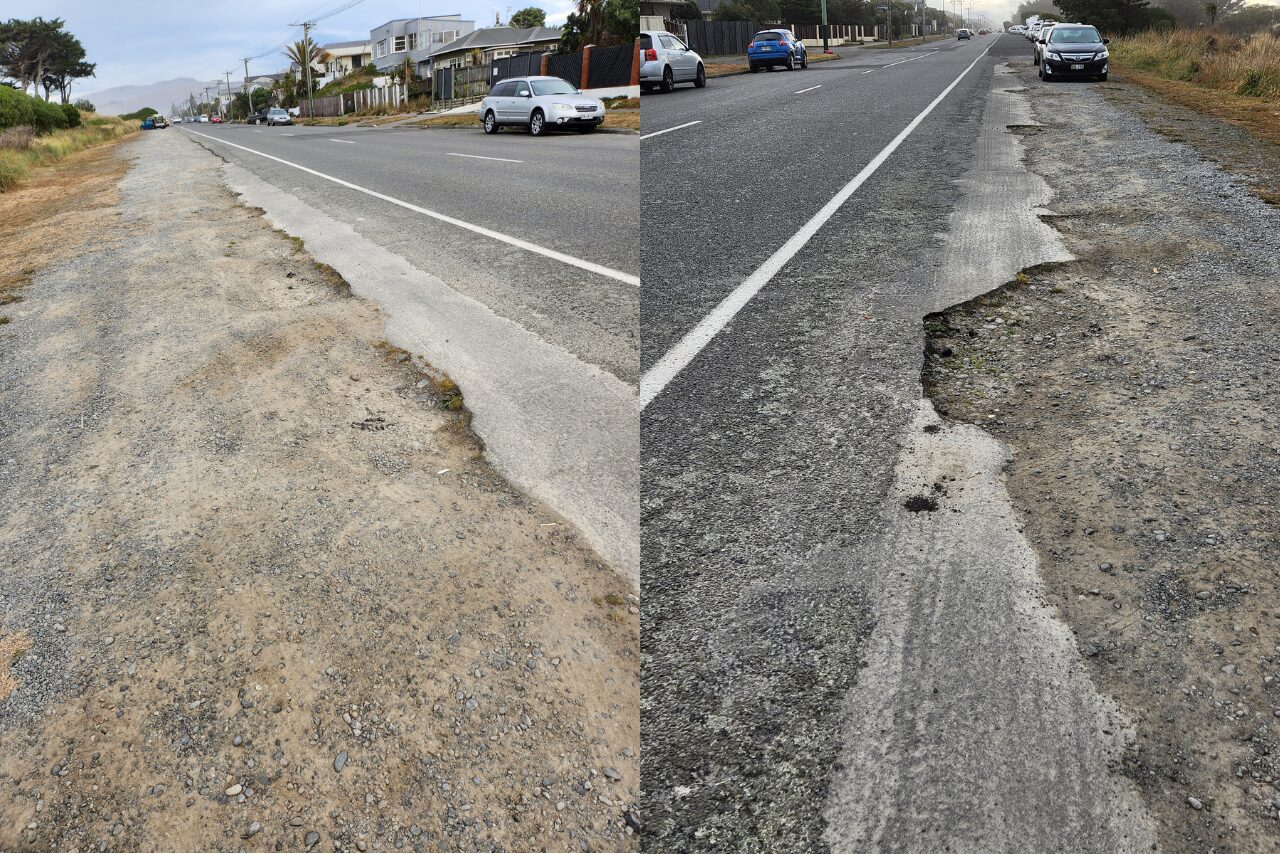
South Brighton's Marine Parade has become a practical test of how quickly Christchurch City Council can turn repeated resident complaints into visible safety work. Local reporting on 10 June said residents had raised concerns about a neglected gravel berm on the beach side of Marine Parade, from the Sturdee Street area toward Jellicoe Street and Halsey Street. The complaint is not about a decorative edge of the road. Residents say cyclists, walkers and wheelchair users are being forced to navigate potholes, loose gravel and traffic pressure on a route that is used to reach the beach.
The council response is the current news point. After questions from local media, a council spokesperson said repairs had been programmed for completion in about six weeks. That gives the story a clear public clock. Residents now have a date range against which to judge whether the issue is treated as a routine maintenance matter or as an accessibility and safety concern that has waited too long.
The disagreement also shows how road-edge spaces can fall between ordinary categories. The council described the area as a berm bordering the parks area that runs parallel to the beach, rather than an established footpath asset or cycleway. That distinction may matter for asset management, but it does not remove the lived use of the place. If people are walking, riding, parking, pushing wheelchairs or helping someone cross around the berm every day, the public risk exists whether the surface is formally labelled a path or not.
Residents' concerns are especially sharp because the affected area is close to a popular beach access point. Marine Parade is not a hidden industrial road. It carries local traffic, beach visitors, recreation users and people moving through a narrow coastal suburb where the road, berm, dunes and houses sit close together. Small maintenance failures in that environment can have outsized effects.
The council has also pointed to a wider planning context, including investigations connected to cycling and shared-path options between Bridge Street and Ebbtide Street as part of the Eastern Orbital project. That may help over time, but residents are asking about a present surface problem. Long-term corridor planning does not replace near-term maintenance where people are already using the space.
For local readers, the useful angle is accountability without exaggeration. This is not a citywide transport crisis, but it is exactly the kind of local issue that decides whether residents trust basic maintenance systems. The council says three maintenance tickets have been raised in the past year and that contractors have inspected the area. Residents say the strip remains unsafe. The six-week programme now creates a simple public test.