Selwyn students have turned sustainability from a classroom topic into practical local action, with Tai Tapu Primary School hosting an Enviroschools day built around student leadership, restoration and everyday environmental projects.
Environment Canterbury said the 7 July event brought students from across Selwyn together to share ideas, learn from one another and show how young people are already leading environmental change in their communities. The day was supported by Environment Canterbury and included teachers and community partners, with activities moving between Tai Tapu Reserve and the school.
The story matters because it gives a different kind of Canterbury news on a day dominated by flooding and road closures. Severe weather shows the region's vulnerability. Student environment projects show the quieter, longer-term work of building local knowledge and responsibility. Both sit in the same regional picture: communities learning how to care for land, water, food systems and shared spaces.
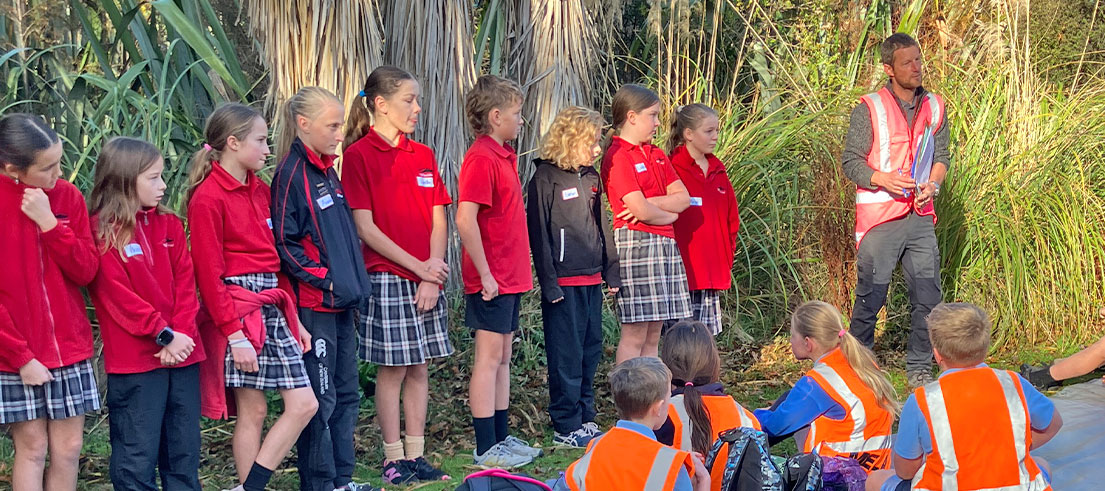
At Tai Tapu Reserve, students learned about efforts to restore native plants and support native birdlife, including tūī. Environment Canterbury said partners from Predator Free New Zealand and Te Ara Kākāriki Greenway Canterbury Trust joined the day, and students took part in a Māori alphabet hunt along the reserve walk. That kind of activity is small in scale, but it connects language, place and conservation in a way that can stay with children better than a worksheet.
The strongest part of the update is that the school projects are practical. Tai Tapu Primary School's Enviroleaders showed visiting students initiatives that are already operating, including a revitalised greenhouse where seasonal produce is grown for cooking classes. Surplus produce goes to the school's sharing shed, a community pantry where people can contribute or take what they need.
The school grounds also include native planting to attract birdlife and a chicken coop. Eggs are sold through the school office to help cover feed costs, and chicken waste is used to fertilise the gardens. That is a simple circular system, but it is exactly the kind of visible loop that helps students understand waste, food, money and soil together rather than as separate subjects.
Waste and recycling were another focus. Environment Canterbury reported that student-led systems have reduced waste volumes and disposal costs by thousands of dollars each year for the small school. That is a concrete result. It also gives other schools a useful test: environmental education has more credibility when students can measure what changed, whether that is rubbish volume, food grown, compost produced, money saved or habitat restored.
The day also extended beyond the school gate. Students heard about work to transform nearby Department of Conservation land into a shared natural space for the community, then helped by spreading mulch and clearing pathways. Tai Tapu students have also helped develop a vision for the site, including bioblitz activities and restoration planting to support the return of native forest.
For families and schools across Selwyn, the useful lesson is that sustainability does not have to begin with a large budget or a perfect plan. It can start with a greenhouse, a sharing shelf, a compost system, waste audits, planting and local partners who know the land. The wider value is cultural as well as environmental: students see themselves as people with agency, not just future adults waiting for permission to act.
That makes this a lifestyle and education story as much as an environment story. It is about how children live in their communities now, how schools can model practical habits, and how local action can make sustainability feel ordinary rather than distant.